













































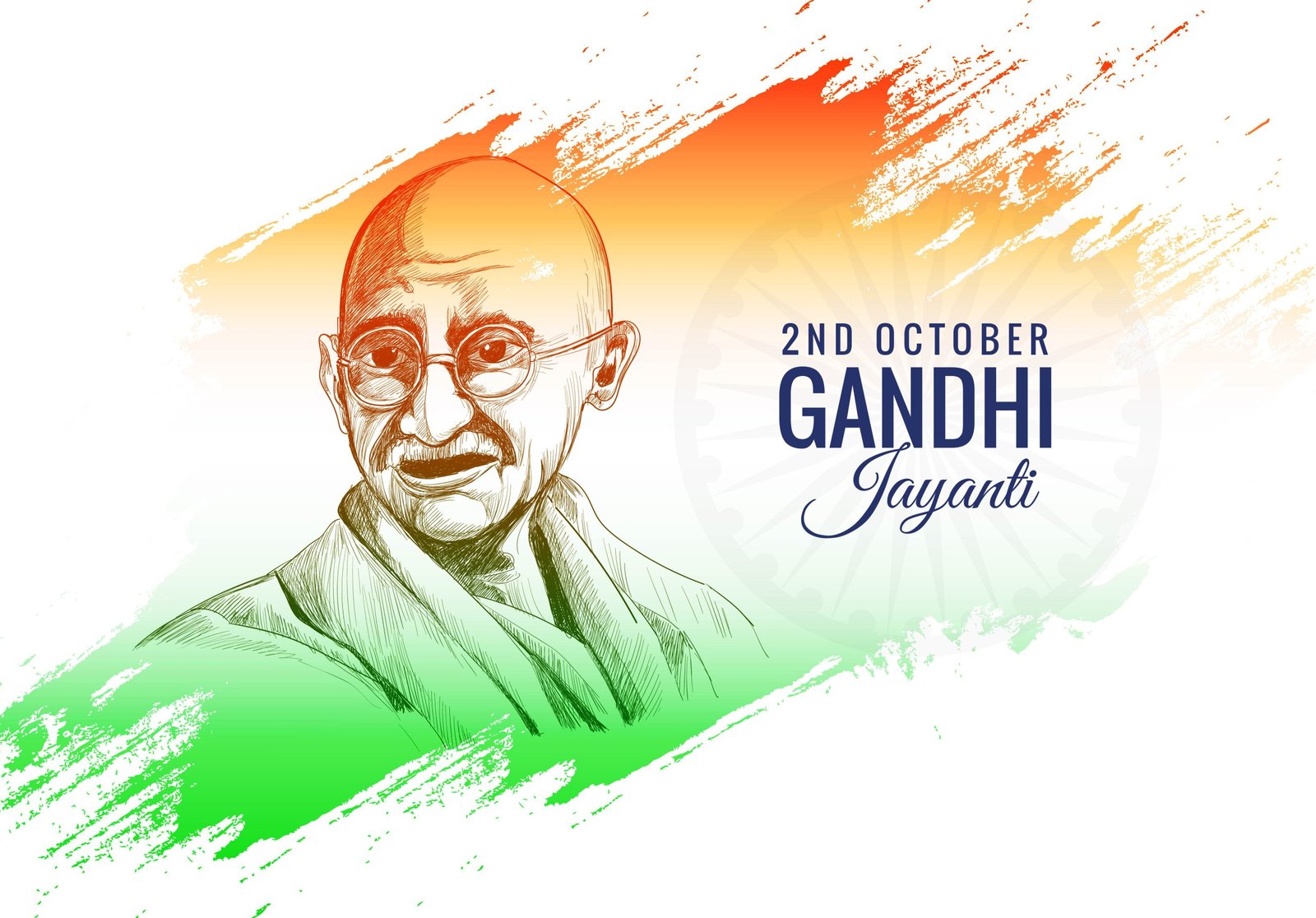
Every year on October 2nd, India commemorates the birth anniversary of one of its greatest leaders, Mahatma Gandhi. This day, known as Gandhi Jayanti 2024, celebrates the life and contributions of Mohandas Karamchand Gandhi, who led India to independence through his philosophies of non-violence (Ahimsa) and truth (Satyagraha). In 2024, Gandhi Jayanti serves as an opportunity not only to reflect on his enduring legacy but also to explore the relevance of his ideas in today’s complex world.
Early Life and Formative Experiences
Born in 1869 in Porbandar, Gujarat, Mohandas Gandhi came from a modest family. HHe grew up immersed in Indian traditions, ethics, and religious tolerance.
Gandhi’s early exposure to diverse religious beliefs, such as Hinduism, Jainism, and Christianity, profoundly influenced his outlook on life.
At the age of 19, Gandhi traveled to England to study law. His time in London broadened his horizons, exposing him to Western philosophies, especially the teachings of the Bible and works of Russian author Leo Tolstoy. However, it was during his time in South Africa, where he faced rampant racial discrimination, that Gandhi began his lifelong journey of social activism. The experience of being thrown off a train because of his skin color became a pivotal moment in his life, leading him to develop the principles of Satyagraha—a form of non-violent resistance that he would later employ in India’s struggle for independence.
Gandhi’s Role in India’s Independence Movement
Gandhi returned to India in 1915, where he became a key figure in the Indian National Congress and the broader independence movement. His vision for India’s freedom was not just about breaking free from British rule, but about building a nation that would uphold truth, equality, and non-violence.
One of his most remarkable campaigns was the Salt March of 1930, also known as the Dandi March. This 240-mile march to protest the British salt tax exemplified Gandhi’s method of non-violent civil disobedience. Thousands of Indians joined him, making salt from seawater, defying the British monopoly. The movement drew international attention to India’s struggle for independence and the effectiveness of peaceful protest.
Gandhi’s leadership inspired several other mass movements, including the Non-Cooperation Movement (1920-22) and the Quit India Movement (1942). Through these efforts, he galvanized millions of Indians from all walks of life—farmers, workers, intellectuals, and women—to participate in the struggle for freedom.
Core Philosophies: Ahimsa and Satyagraha
Central to Gandhi’s philosophy were the principles of Ahimsa (non-violence) and Satyagraha (truth-force). These ideas were not merely theoretical; they were strategies for social change that Gandhi practiced throughout his life. For Gandhi, Ahimsa meant more than the absence of physical violence; it also referred to the avoidance of harm through words, thoughts, and actions. He believed that non-violence was the most powerful weapon for oppressed people to resist injustice without dehumanizing their oppressors.
Satyagraha, on the other hand, was Gandhi’s unique form of political resistance. It emphasized the power of truth and moral courage. Unlike violent revolutions, Satyagraha focused on transforming the hearts and minds of opponents through peaceful resistance and dialogue. Gandhi believed that enduring suffering for a just cause could evoke the humanity of even the most oppressive rulers.
Gandhi’s Influence on Global Movements
Gandhi’s philosophy of non-violence had a profound impact far beyond India’s borders. His methods inspired civil rights movements around the world, most notably the American Civil Rights Movement led by Dr. Martin Luther King Jr. In South Africa, Nelson Mandela drew upon Gandhi’s ideals in the fight against apartheid.
Gandhi’s commitment to justice, equality, and non-violence also resonated with movements for social change in other regions, including the struggle for independence in African nations, civil rights in the U.S., and anti-colonial movements across Asia. His belief that peaceful means could achieve profound political and social transformation continues to inspire activists and leaders globally, making Gandhi Jayanti 2024 a significant occasion to reflect on his lasting influence.
Gandhi’s Vision for India: Swaraj and Sarvodaya
While Gandhi is best known for his role in the independence movement, his vision for India extended far beyond political freedom. He advocated for Swaraj (self-rule), which was not merely about driving the British out but also about building a nation rooted in self-reliance, democracy, and moral integrity.
Gandhi emphasized the importance of Gram Swaraj, or village self-governance, as the foundation of India’s future.He believed that true democracy would emerge only when the country’s villages, the backbone of India, empowered themselves to govern locally and achieve economic self-sufficiency. His emphasis on spinning the charkha (spinning wheel) and promoting khadi (handwoven cloth) was symbolic of this vision, as it represented a break from the dependence on foreign goods and industrialization.
Moreover, Gandhi’s concept of Sarvodaya (the welfare of all) was a vision for a just and equitable society. He dreamed of a nation where the needs of the poorest and most marginalized were met first. His idea of development was fundamentally ethical and humanitarian, challenging the materialism and inequality that he believed would emerge from industrialized capitalism.
Gandhi’s Relevance in Today’s World
As we celebrate Gandhi Jayanti 2024, it is crucial to reflect on the relevance of Gandhi’s teachings in today’s world. Although Gandhi lived in an era very different from our own, his principles of non-violence, truth, and justice remain as powerful and necessary as ever.
In a world marked by political polarization, social unrest, and global conflicts, Gandhi’s message of peaceful resistance and dialogue can offer valuable lessons. His commitment to equality, environmental sustainability, and the welfare of all provides a blueprint for addressing many of the pressing challenges we face today, including poverty, environmental degradation, and social inequality.
Additionally, in the context of modern-day India, Gandhi’s teachings remind us of the need to stay true to the values of pluralism, tolerance, and communal harmony. In an increasingly globalized world, where violence and hatred often dominate headlines, Gandhi’s vision for a peaceful, inclusive, and just society continues to inspire.
The Global Celebration of Gandhi Jayanti
Gandhi Jayanti is not only celebrated in India but also globally. The United Nations has recognized October 2nd as the International Day of Non-Violence, underscoring the global impact of Gandhi’s philosophy. On this day, people from all walks of life come together to honor his legacy by participating in events that promote peace, non-violence, and social justice.
In India, the day is marked with prayer meetings, cultural events, and tributes at Raj Ghat, Gandhi’s memorial in New Delhi. Schools and communities hold discussions on his life, and various organizations engage in charitable activities to embody the spirit of Sarvodaya.